

Canton POS

Good Times: The Artistic Journey of Ernie Barnes (August 18, 2026- November 1, 2026)
The Canton Museum of Art is proud to present Life in Motion: The Artistic Journey of Ernie Barnes in collaboration with the Estate of Ernie Barnes. The exhibition will include the work, Study II for The Dream Unfolds, 1996, recently purchased by the museum.
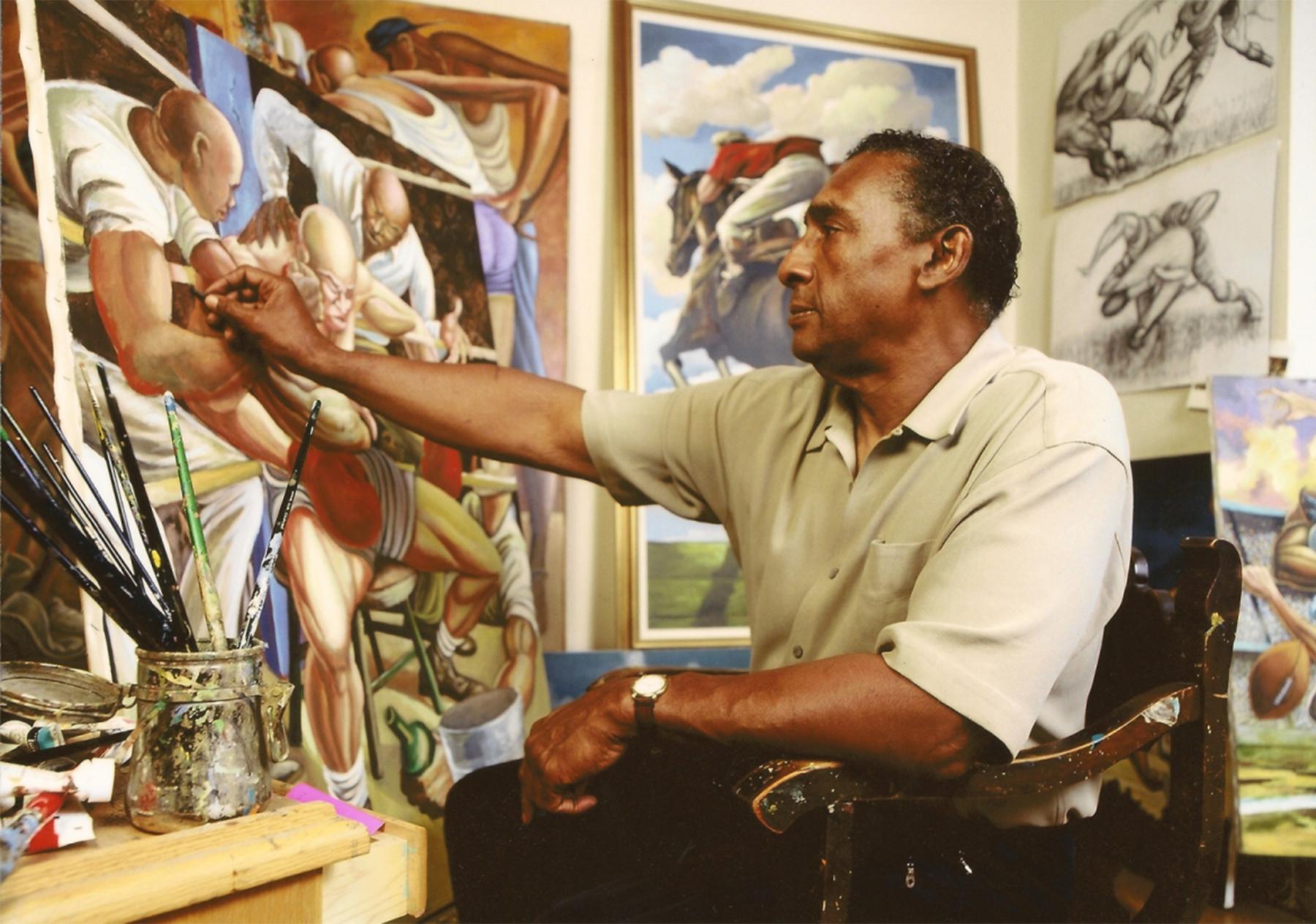
(Above: Portrait of Ernie Barnes, 1996. Courtesy the Estate of Ernie Barnes, Ortuzar, New York, and Andrew Kreps Gallery, New York.)
Born in segregated Durham, North Carolina, on July 15, 1938, Ernest Eugene Barnes, Jr., was the son of a shipping clerk and a domestic worker who managed the household of a prominent attorney. This connection to his mother's employer proved pivotal, as it provided Barnes with an early introduction to the works of classical masters like Rubens, Michelangelo, and Toulouse-Lautrec.
These formative encounters allowed Barnes to bridge the gap between classical art history and the "spiritual currency of the ghetto," a term he used to describe the profound soul of the American South. His artistic journey culminated in a unique "neo-mannerist" style, characterized by the sinuous, elongated limbs and closed eyes of his subjects—a technique influenced by Italian Mannerism and 20th-century American masters such as Charles White, Andrew Wyeth, and Thomas Hart Benton. Through this lens, he captured lyrical portrayals of Southern life alongside vibrant depictions of athleticism and Black joy.
Despite being frequently sought after for his imposing physical build, Barnes originally steered clear of sports by claiming his mother had prohibited him from participating. This changed in high school when he discovered the team captain and head football coach in his kitchen, bargaining with his mother. By offering a donation to her missionary fund, the coach—who also hosted a weekly Christian Gospel program—secured her permission. The following day, Barnes joined the team as #73. He went on to receive 26 athletic scholarship offers upon graduation from high school and chose to attend North Carolina College (now known as North Carolina Central University), where he pursued a major in art supported by a full athletic scholarship.
After being drafted by the Baltimore Colts in 1959 and subsequently placed on waivers, Barnes joined the Titans of New York for the 1960 AFL season. His professional football career continued with a two-season stint with the Los Angeles Chargers from 1961 to 1962, before concluding his time in the NFL with the Denver Broncos between 1963 and 1964.
Following his transition from the professional gridiron, Barnes sought to formalize his artistic career by attending an NFL owners' meeting to solicit financial patronage. This bold move attracted the interest of New York Jets owner Sonny Werblin, who invited Barnes to present his portfolio in New York, providing a stipend for his travel and expenses. Unbeknownst to Barnes, Werblin had arranged for art critics to be on hand to critique his work. Those critics told Werblin that Barnes was "the most expressive painter of sports since George Bellows.” Upon receiving the favorable assessment from art critics, Werblin commissioned a collection of six to seven paintings to be completed within six months, offering a salary commensurate with Barnes' final NFL season. This patronage culminated in his inaugural solo exhibition at the prestigious Grand Central Art Galleries in November 1966.
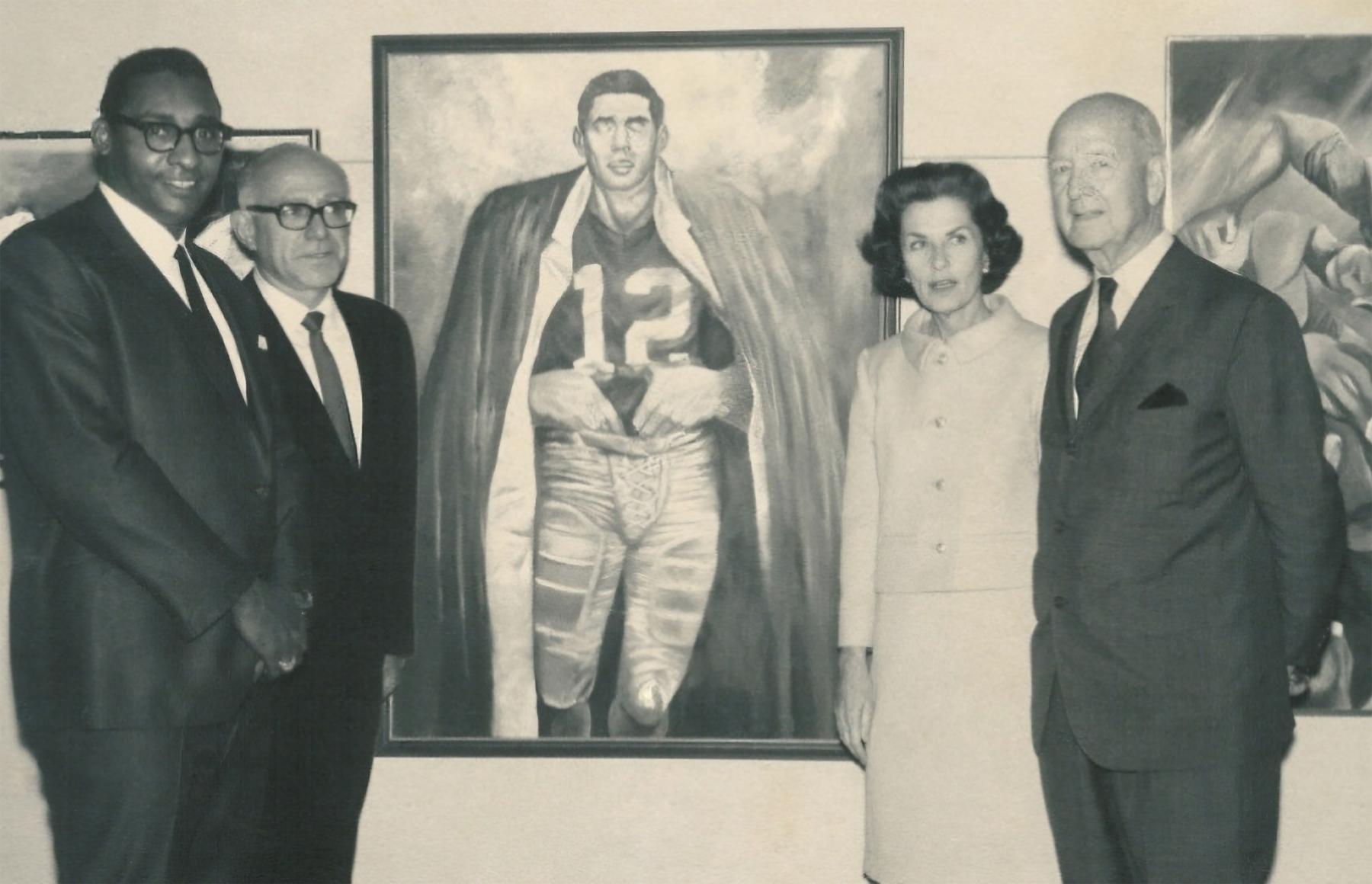
(Right: Ernie Barnes with Sonny Werblin at his first major solo exhibition in 1966, hosted by Werblin at Grand Central Art Galleries in New York. Courtesy the Estate of Ernie Barnes, Ortuzar, New York, and Andrew Kreps Gallery, New York.)
Barnes' work was characterized by intricate, multi-dimensional compositions that merged his background as a professional athlete with the rural Southern surroundings of his childhood. His evocative paintings and works on paper addressed a broad spectrum of themes, ranging from the rhythmic energy of R&B dance halls to the powerful physical forms of athletes and the ingenuity of young men playing basketball with makeshift peach-baskets.
His creative influence extended into popular culture, notably appearing in the television series Good Times, where much of the artwork “created” by the character J.J. Walker was in fact painted by Barnes. Furthermore, his paintings appeared on the album covers of legendary musicians including Marvin Gaye, B.B. King, Curtis Mayfield, and The Crusaders among others.
A socially progressive figure, Barnes confronted the media's limited depictions of impoverished Black youth by uncovering deep significance within the experience of poverty. He worked to overturn the era's prevailing view of Black art as "culturally blind," creating works that exposed the contradictions of the "culturally deprived" stereotype while honoring Black excellence and vitality.
Ernie Barnes has been the subject of several recent solo exhibitions, including Ernie Barnes: In Rapture, Ortuzar, New York (2024); Ernie Barnes: Where Music and Soul Live, UTA Artist Space, Los Angeles (2023); Ernie Barnes, Andrew Kreps Gallery, organized with Ortuzar Projects, New York (2021); Liberating Humanity from Within, UTA Artists Space, Los Angeles (2020); Ernie Barnes: A Retrospective, California African American Museum, Los Angeles (2019); and The North Carolina Roots of Artist Ernie Barnes, North Carolina Museum of History, Raleigh, North Carolina (2018-2019), among others. His work has been featured in institutional survey exhibitions including America 250: Common Threads, Crystal Bridges Museum of American Art, Bentonville, AR, (2025-2026); Get in the Game: Sports, Art, Culture, San Francisco Museum of Modern Art, San Francisco, California (2024-2025); Giants: Art from the Dean Collection of Swizz Beatz and Alicia Keys, Brooklyn Museum, Brooklyn, New York (2024); Dix and the Present, Deichtorhallen Hamburg, Hamburg, Germany (2023); Scrimmage: Football in American Art from The Civil War to The Present, University Art Museum at Colorado State University, Fort Collins, Colorado (2015); traveled to Jordan Schnitzer Museum of Art, Eugene, Oregon (2016); Figge Museum of Art, Davenport, Iowa (2017); Canton Museum of Art, Canton, Ohio (2017); Visual Voice, Riverside Art Museum, Riverside, California (2016); I Got Rhythm: Art & Jazz Since 1920, Kunstmuseum Stuttgart, Stuttgart, Germany (2015).
Barnes’ work is currently held in the permanent collections of the Canton Museum of Art, Canton, Ohio; California African American Museum, Los Angeles; Pro Football Hall of Fame, Canton, Ohio; Brigham Young University Museum of Art, Provo, Utah; North Carolina Museum of Art, Raleigh, North Carolina; North Carolina Central University Art Museum, Durham, North Carolina; and the American Sport Art Museum and Archives, Daphne, Alabama, among others.
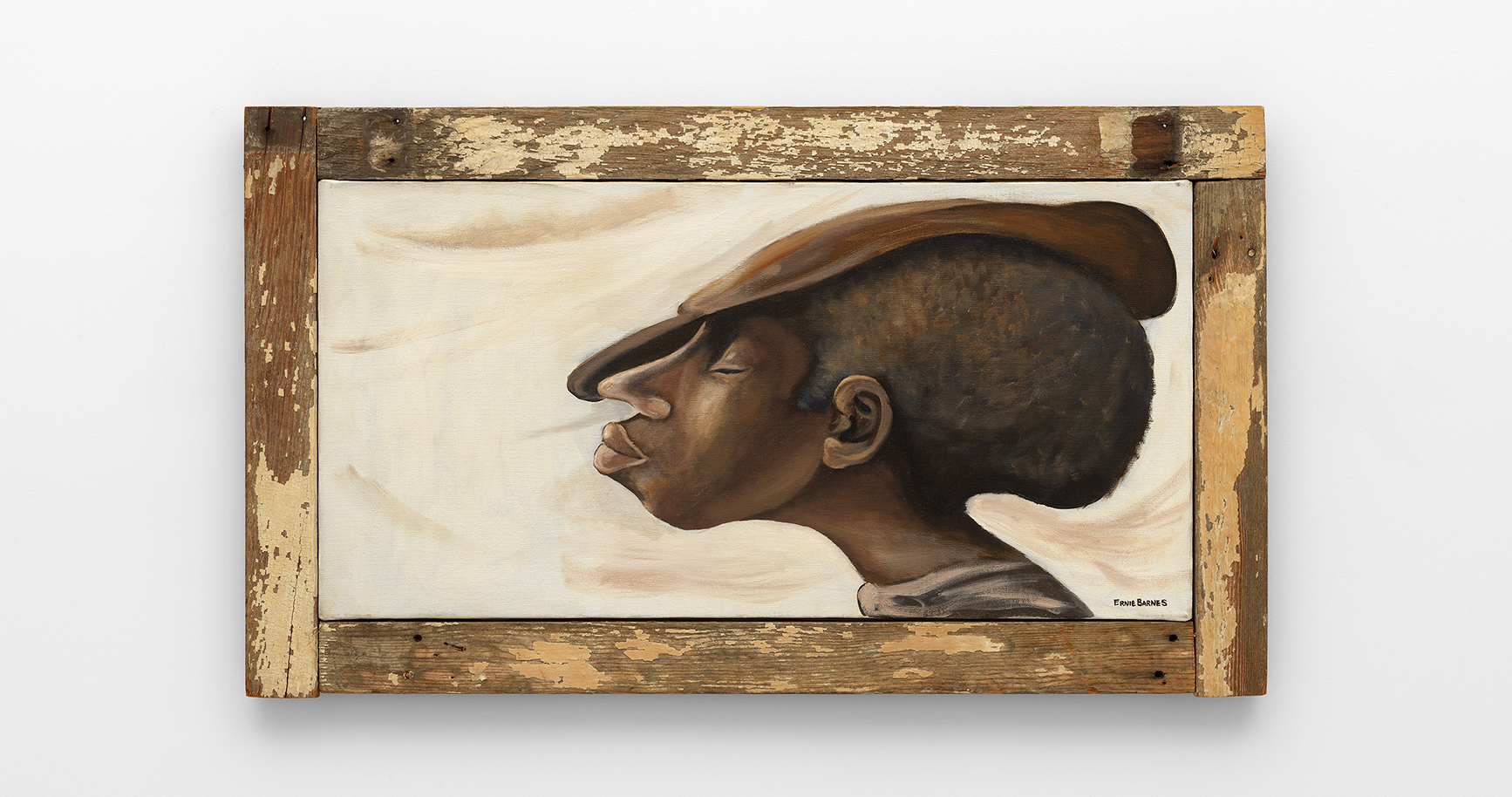
Above Image: Ernie Barnes, My Man Worm, 1980. Acrylic on canvas, in artist’s frame; 15 x 30 inches (38.1 x 76.2 cm). Private Collection. Courtesy the Ernie Barnes Estate, Ortuzar, New York, and Andrew Kreps Gallery, New York. Photo: Dario Lasagni.
Thumbnail Previous Page: Ernie Barnes, Air Guitar (detail), 1999. Acrylic on paper; 37 7/8 x 25 5/8 inches (96.2 x 65.1 cm). The Estate of Ernie Barnes. Courtesy the Ernie Barnes Estate, Ortuzar, New York, and Andrew Kreps Gallery, New York. Photo: Dario Lasagni.
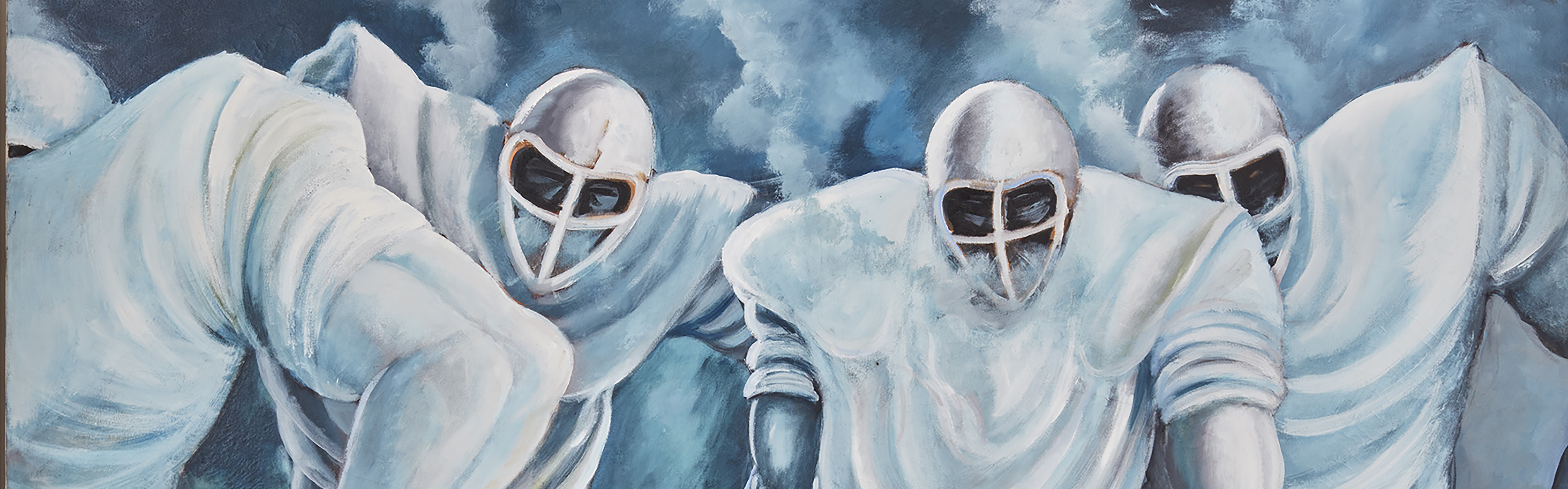
Banner: Ernie Barnes, Climatic Conditions (detail), 1995. Acrylic on canvas; 48 x 60 inches (121.9 x 152.4 cm). Private Collection. Courtesy the Ernie Barnes Estate, Ortuzar,New York, and Andrew Kreps Gallery, New York. Photo:Tim Doyon.